
View Connecticut Police Blotter Records
Connecticut police blotter records offer a window into recent law enforcement activity across the state. You can search incident reports, arrest logs, and accident records from local police departments and the State Police. Most police blotter entries are public records under Connecticut law. You may view these documents online or request copies in person. The process is simple and open to all residents.
Connecticut Police Records Quick Facts
Where to Find Connecticut Police Blotter Records
Police blotter records in Connecticut come from two main sources. Local police departments maintain daily logs. The Connecticut State Police also keep records. These sources provide arrest logs and incident reports. They document calls for service and motor vehicle accidents. Each department handles its own requests. You must contact the specific agency involved. This ensures you get the right police blotter entry. Connecticut has 169 towns and cities. Most have their own police departments. Each department maintains its own records division.
The Connecticut Department of Emergency Services and Public Protection (DESPP) oversees State Police operations and all related records. Connecticut State Police cover 26 towns that lack local police departments. They also respond to major incidents on state highways and at state facilities. DESPP maintains a central records unit at 1111 Country Club Road in Middletown, Connecticut. This office processes all requests for State Police incident reports, arrest records, and accident documentation. They handle thousands of requests each year from residents and insurance companies.
Many Connecticut police departments now post daily police blotter logs on their official websites. Some departments offer searchable databases for recent arrests and incidents. Other departments post PDF files with police blotter information. Check your local police department website first. You may find the incident reports or arrest logs you need. Online police blotter records are often free. Some Connecticut departments update these logs daily.
The DESPP homepage provides resources for finding police records throughout Connecticut. You can also visit the Reports and Records Unit in person. Their office is in Middletown. They operate Tuesday through Thursday from 9am to 2pm. Call (860) 685-8480 with questions. They can help with Connecticut State Police records. They also handle arrest logs and incident reports.
How to Request Connecticut Police Blotter Reports
You have several options for obtaining police reports in Connecticut. The best method depends on the agency involved. For local police matters, contact the records division. Most Connecticut towns accept requests in person. They also accept requests by mail. Some offer online portals. Bring a valid photo ID. Some departments require advance notice.
For Connecticut State Police reports, use the DESPP GovQA request portal. This online system allows you to submit requests for State Police incident reports, arrest records, and accident reports. Create a free account to track your request status and receive updates. You will need the incident date, location, and case number if available. The GovQA portal accepts credit card payment for any search fees or copy charges due for your Connecticut police blotter records.
You may also submit written requests by mail to the DESPP Reports and Records Unit in Middletown, Connecticut. Include your full name, mailing address, phone number, and specific details about the incident. Describe what occurred, including the date, time, and exact location in Connecticut. Include payment for the $16 search fee required by state law. Send completed requests to 1111 Country Club Road, Middletown, CT 06457. Allow several weeks for processing of mail requests for police blotter records or incident reports.
Accident reports in Connecticut follow a separate request process. The state offers free access to motor vehicle accident reports for 30 days after the crash occurs. Visit the Accident Information Summary database to search and download these police blotter accident records. This online service costs nothing during the first 30 days after an accident. After that 30-day period expires, you must request accident reports through DESPP or purchase them from BuyCrash.com.
Connecticut drivers involved in accidents can obtain their crash reports quickly through the online Accident Information Summary system. You will need the accident date and one additional piece of information: either the report number, a driver name, or a vehicle plate number. The Connecticut accident database covers all police departments and State Police troops that use the state reporting system. This includes most towns in Connecticut.
Note: Some police reports may be withheld if they are part of an active criminal investigation or contain sensitive victim information protected by law.
Connecticut Police Blotter Accident Database
The state of Connecticut provides a free online tool for accessing motor vehicle accident reports through the DESPP. Visit the Accident Information Summary database to search for crash reports from police departments statewide. This central system contains accident records from municipal police and Connecticut State Police.
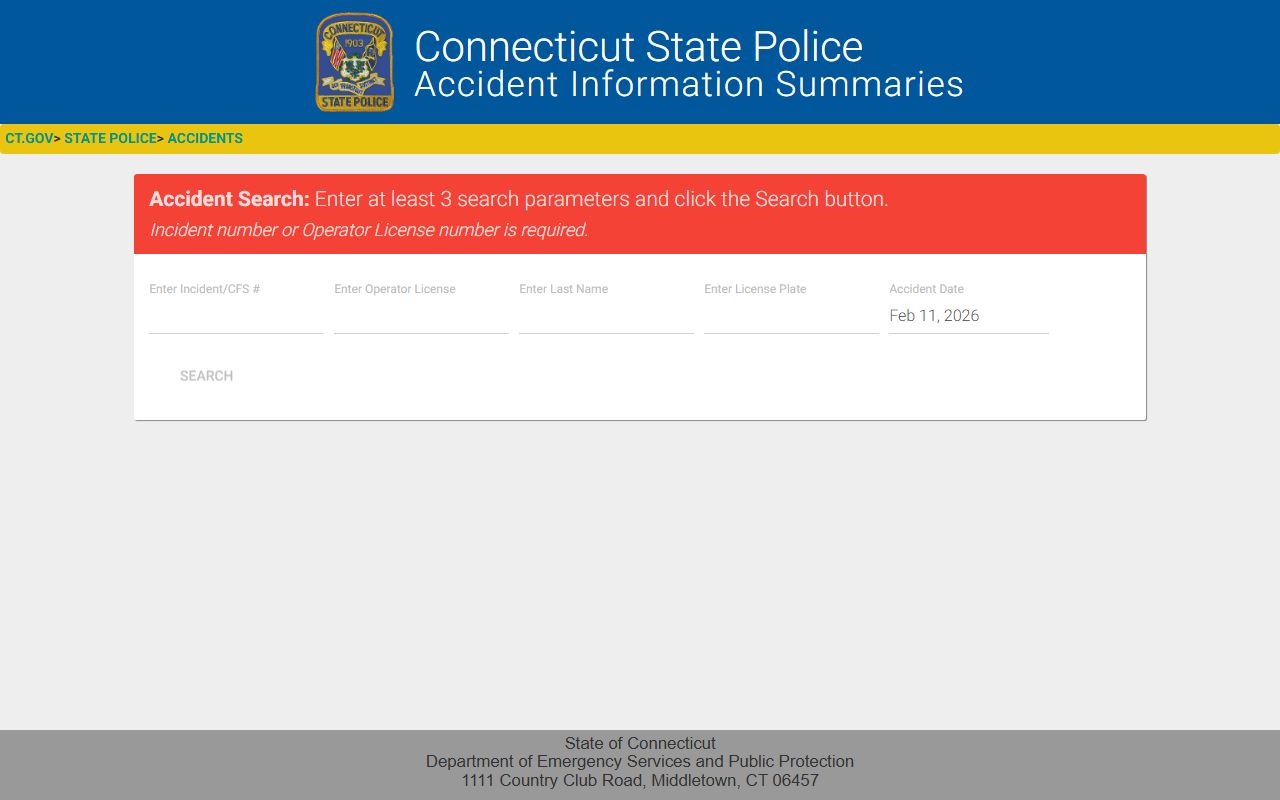
Accident reports remain free for 30 days from the crash date. After that period expires, fees apply through third-party vendors. This database makes it easy to obtain official proof of a motor vehicle accident for insurance claims.
Connecticut Police Blotter State Coverage Areas
Connecticut is unique among American states. It has no county sheriff system. Law enforcement falls to municipal police or State Police. Towns without local departments rely on State Police. They provide all police services. This includes patrol and investigation. State Police cover 26 towns across Connecticut.
Connecticut State Police also patrol all state highways and interstates throughout the state. They respond to motor vehicle accidents on I-95, I-84, I-91, Route 2, and other major roads. The agency operates from multiple troop locations positioned strategically around Connecticut. Each troop covers a specific geographic region of the state. Troop A serves southwestern Connecticut including Bridgeport. Troop B covers the northwest corner including Canaan. Troop C handles the central region including Hartford. Troop D covers eastern Connecticut including Danielson. Troop E patrols the southeast including Montville. Troop F serves the Windham area. Troop G covers south central Connecticut. Troop H serves the greater Hartford area. Troop I covers New Haven and surrounding towns. Troop K serves the northeast. Troop L handles the Connecticut River valley.
State Police maintain complete police blotter records for all incidents in their coverage areas. These include arrests, motor vehicle accidents, criminal investigations, and calls for service. You can request these records through the DESPP Reports and Records Unit in Middletown. Some troops also post recent arrests and incident summaries on their individual websites.
The State Police Bureau of Identification handles criminal history record checks and fingerprinting services. Their office is located at 1111 Country Club Road in Middletown, Connecticut. Operating hours are Tuesday, Wednesday, and Friday from 7:45am to 4pm. Thursday hours are 9:15am to 5:30pm. Saturday hours are 8am to 12:30pm. The office is closed Sunday and Monday. Call (860) 685-8480 for more information about identification services or police record requests.
Types of Connecticut Police Blotter Records
Connecticut police departments maintain various types of public records. Each record type serves a different purpose. Understanding these differences helps you request the right police blotter document for your needs.
Incident reports document calls for police service in Connecticut towns. These include theft reports, vandalism complaints, domestic disputes, noise violations, and other non-criminal matters. An incident report shows the date, time, location, and nature of the police call. It may include witness statements and officer observations about what occurred. Not all incidents result in arrests or criminal charges.
Arrest records show when Connecticut police take a person into custody. These police blotter records include the suspect's name, specific charges, and arrest date and time. Arrest logs are often posted daily on department websites as part of the public police blotter. They provide a snapshot of recent criminal activity in a Connecticut town.
Accident reports document motor vehicle crashes investigated by Connecticut police. They include driver information, vehicle details, insurance information, and crash scene diagrams. Insurance companies typically require these police reports for processing claims. Connecticut makes accident reports available free online for 30 days.
Police blotters are daily summaries of all department activity during a shift. They list calls for service, arrests, accidents, and incidents from each patrol period. Many Connecticut departments post these as public logs on their websites. Police blotters offer a quick overview of local public safety activity.
The following Connecticut police blotter records are typically available to the public under state law:
- Incident and offense reports
- Arrest logs and booking records
- Motor vehicle accident reports
- Daily police blotter logs
- Citations and summons records
Some police records may be exempt from public disclosure under Connecticut law. These include active criminal investigation files, juvenile records, and certain victim information. Police departments must follow state law when releasing or withholding records.
Connecticut Police Blotter FOI Laws
Connecticut's Freedom of Information Act governs public access to police records and police blotter information. The Connecticut FOI Commission oversees these rules and handles disputes. They ensure public access to government documents including police records. Police blotter records are generally public under Connecticut state law.
Connecticut General Statutes §1-210 defines what constitutes a public record in the state. It states that all records maintained by public agencies are open to public inspection. This includes municipal police departments and the Connecticut State Police. The law presumes records are public unless a specific exemption applies.
CGS §1-215 specifically addresses the disclosure of arrest records and police blotter information. It requires police to disclose the name and address of any arrested person. The statute also requires disclosure of the date, time, and place of arrest. Charges and other relevant details must also be released to the public. This law ensures that basic police blotter information remains accessible to Connecticut residents and the press.
Connecticut agencies must respond to FOI requests within four business days. They must acknowledge receipt of your request in writing. If they deny the request, they must state the specific legal basis for denial. You have the right to appeal any denial of access. The FOI Commission handles these appeals. You have 30 days from the denial to file an appeal with the Commission.
The FOI Citizen's Guide explains your rights in plain language without legal jargon. It covers how to make effective requests and what to expect from agencies. The guide also explains the appeal process step by step. You can contact the FOI Commission at 165 Capitol Avenue, Suite 1100, Hartford, CT 06106. Their phone number is (860) 566-5682.
Note: FOI requests should be specific about the exact police blotter records you seek to ensure a timely response from the Connecticut agency.
Connecticut Police Blotter Fees and Processing
Costs for obtaining police blotter records vary by agency and record type in Connecticut. Understanding the fee structure helps you budget for your request. Some police records are free. Others require payment before the agency will release documents.
The standard search fee for Connecticut State Police records is $16 per incident. This fee is non-refundable under CGS §29-10b. You must pay this fee even if no records are found. The charge covers the cost of searching files and processing your request. Additional copy fees may apply depending on the number of pages.
Copy fees for police records follow CGS §1-212. The standard rate is $0.50 per page for photocopies of police reports. Some Connecticut agencies may charge for staff time if requests are complex or require extensive research. Large requests for police blotter records may take longer to process.
Motor vehicle accident reports are free for 30 days through the online Accident Information Summary database. After the 30-day period expires, fees apply for obtaining accident reports. BuyCrash.com charges for older accident reports from Connecticut. Prices vary based on the delivery method you select.
Local police departments in Connecticut set their own fee schedules for records. Many charge similar rates to the state for incident reports and police blotter copies. Some smaller departments may have lower fees for public records. A few Connecticut departments offer free copies to victims of crimes. Contact the specific department directly to learn their current fee schedule.
Processing times for police records vary across Connecticut. Simple requests for recent incident reports may take a few business days. Complex requests or older police blotter records may require several weeks. State law does not set a strict deadline for producing records. Agencies must respond promptly to all requests. Large or complex police record requests may require additional processing time.
Browse Connecticut Police Blotter by County
Connecticut has eight counties that each contain multiple towns with local police or State Police coverage. Select a county below to find police blotter resources and incident report procedures in that area.
Police Blotter Records in Major Connecticut Cities
Large cities in Connecticut maintain active police departments with daily police blotter updates and public record systems. Choose a city below to access local police records and incident report information.